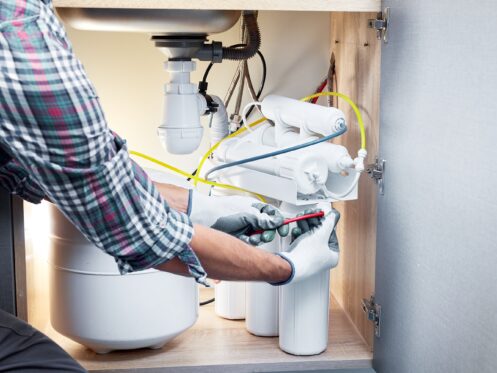
Reverse osmosis is one of the most aggressive ways to remove contaminants from water, especially if you’re dealing with several water quality issues at once. Before adopting an RO system, however, you may want to learn more about how it works and whether it’s a good fit for your home.
Understanding Osmosis
In nature, any material in a water solution wants to diffuse from where there’s more of the material to where there’s less. Anyone who has ever put a dropper full of food coloring in a glass of water has watched the cloud of color spread out. This process is osmosis.
Osmosis has a few unfortunate consequences for water quality. First, water likes to absorb many materials as it passes from its source to your house. If it goes through a pipe, it wants to pick up whatever is there, including minerals and metals like calcium, iron, manganese, or zinc. In the worst-case scenario, the water could even pick up lead.
Also, water likes to pick up all kinds of pathogens. If your house has well water, there might be bacteria, mold, or viruses present.
Reverse Osmosis
The point of water treatment service is to get rid of as many of these undesirable contaminants as possible. In many cases, passive filtration is enough to remove things from the water. For example, activated charcoal is a perfectly fine way to remove the chlorine that municipal water suppliers use to kill pathogens. A passive system just lets the water flow through the filter material. The material then either reacts to or catches the contaminant, thus removing it.
However, this process isn’t always sufficient. Reverse osmosis uses water pressure to force water through a very fine membrane. Instead of allowing a diffuse solution of minerals, salts, metals, and pathogens through, RO only allows things as small as or smaller than a water molecule through. The pores in an RO membrane measure 0.0001 microns wide, more than small enough to limit all but the finest contaminants.
Water Pressure
Notably, applying water pressure to the water requires an energy source and additional water to increase the pressure. A pumping system may be necessary to flush the untreated side and force the water molecules through the pores. All but the smallest contaminants are stuck on the intake side. The system then flushes those away.
Effectiveness
Overall, typical reverse osmosis systems will remove more than 90% of the contaminants in water. Some high-performance systems achieve closer to 98%. You can expect an RO system to remove at least:
- 95% of lead
- 90% of arsenic
- 85% of fluoride
- 98% of chlorine
- 99% of calcium
- 95% of dissolved salts
- 99% of non-dissolved salts
- 90% of total dissolved solids (TDS)
Need for Pre-Filtration
Very few homeowners use a standalone reverse osmosis filter. There are several reasons. Foremost, there is little sense in using an RO membrane to filter what could be filtered with a cheaper product. For example, you can usually remove large sediment with a more basic sediment filter. This improves the lifespan of the RO membrane. It also improves its efficiency because the system doesn’t have to flush large amounts of sediment.
Activated carbon is also a key pre-filtering step. While RO membranes do an excellent job of removing chlorine, the chemical tends to break down the membranes. Activated carbon filters are cheap, so pre-filtration is a very cost-effective way to extend the membrane’s lifespan.
Many homeowners elect to use additional pre-filtration methods for additional thoroughness. If someone has well water and good reason to fear pathogens, for example, they may add a UV-C light filter to kill the pathogens. Coupled with reverse osmosis, UV radically reduces the amount of pathogens in a home’s water.
Some people also use water softener systems to pre-treat minerals like calcium and magnesium. Not only does this take some of the burden off the RO filtration unit, but it also protects the plumbing system leading into the unit by preventing mineral buildup.
Is Reverse Osmosis Right for You?
Reverse osmosis is one of the less-used of the more common water filtration methods. Understandably, many households are happy with what they get from their municipal water supply and perhaps an activated carbon or charcoal filter. However, there are many cases where reverse osmosis is a better choice, an excellent supplement, or even possibly the only choice.
Specific Water Quality Issues
Some locations have specific water quality issues that are only suited to RO filtration. If your area has high lead concentrations due to old municipal pipes, for example, reverse osmosis is the best way to guarantee it won’t end up in your drinking water. Well water can also be an issue in areas with agricultural run-off, particularly nitrates and pesticides.
High Total Dissolved Solids
Another occasional issue with water quality in municipal systems is high levels of total dissolved solids. If someone in your household has had health issues related to mineral levels, it could be due to high TDS in the water. Some folks experience digestive distress. Folks with cardiovascular problems may experience higher levels of sodium intake. Similar problems can occur in individuals with kidney problems.
High TD also affects the taste of water. Some people avoid drinking as much water as they should because of unpleasant TDS levels. This may lead to light levels of dehydration.
Redundancy
Even if other filtration options are largely sufficient, some homeowners like the redundancy of having an RO system. This offers protection between filter changes and water softener replacements. It also adds another level of thoroughness to the filtration process.
Considerations
Intensiveness
Reverse osmosis water filtration is intensive compared to other solutions. If a booster pump is necessary to boost water pressure, it might add about 3 kWh per year to your bill.
Flushing the membrane is the more intensive part. Most RO systems operate at about ¼ efficiency, meaning it takes four gallons of water to flush out one gallon of treated water. Newer systems tend to be more efficient, and even older designs can reuse much of the flushed water. Expect to see about a $2 increase in your water bill per month.
Available Water
A typical RO system will produce about 50 gallons of filtered water per day. Consequently, it is best to only use RO water filtration for water that’s for human consumption. Other, more cost-effective filtration options are more than suitable in nearly all cases for protecting appliances, plumbing fixtures, pipes, and drains.
Plumbtree Plumbing & Rooter offers a variety of plumbing and water services to residents of San Jose, CA and the Greater Silicon Valley region. From routine installations to repairs and maintenance, our skilled plumbers always deliver. We even maintain 24/7 emergency availability.
Our business is BBB-accredited, Diamond Certified, a Home Advisor Top Rated service provider, and a Yelp Nextdoor Neighborhood Favorite. You can also rely on us because our company is state-licensed. Our online reviews are positive, too.
If you have questions about reverse osmosis water filtration for a home in or near San Jose, contact Plumbtree Plumbing & Rooter today.