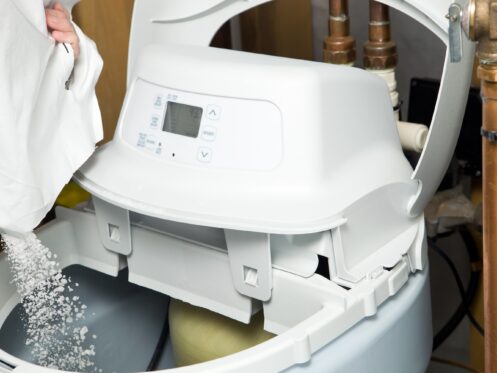
The Department of Energy (DOE) recommends a whole-house water softener for most U.S. homes. That’s because a water softener will typically pay for itself through lower home upkeep costs. Let’s explore the specific indications that your home would benefit from a water softener.
Water Testing
The best way to determine if your water hardness is high enough to justify a water softener is through testing. Experts recommend regular testing for all households, particularly in areas where hard water is common. It’s important to note that just because a region has hard water doesn’t necessarily mean your property will. Likewise, you can experience elevated water hardness despite living in an area known for soft water. Likewise, water filtration and softening aren’t the same. Most filters don’t remove hardness minerals.
Well vs. Municipal Water
There’s no guarantee your water is hard because you have a well system or soft because you have municipal water. Hardness is more common with wells because the groundwater directly passes through rock and soil. Still, water companies generally get their water from local sources, too. While some providers soften their supplies, it isn’t common.
Seasonal Fluctuations
It’s also worthwhile to note that water hardness isn’t static. Generally, a hard water supply won’t suddenly become soft or vice versa. That said, there will be fluctuations throughout the year, particularly season to season. When making decisions for your home, it’s important to base them on the projected high end of the range. This is why summer is the ideal time to test for water hardness throughout much of the U.S.
How Often to Test
Most experts recommend testing your water supply annually. Have a professional test for both water hardness and impurities. Testing regularly for pollutants and contaminants is good advice even for homes with municipal supplies. It can reveal local problems that publicly available water quality reports won’t reflect.
Water Hardness Criteria
Hardness is the result of calcium, magnesium, and various metals. The U.S Geological Survey (USGS) generally classifies hardness as such:
- Soft: 0-60 milligrams per liter
- Moderately hard: 61-121 mg/L
- Hard: 121-180 mg/L
- Very hard: 181 mg/L and above
Homes with soft water don’t need water softening, but that’s less than 15% of properties according to the USGS. If you have moderately hard water, whether you need a water softener depends, but the DOE does generally recommend it. Property owners with hard or very hard water will most certainly benefit from the installation of a water softener.
Visible Scale Buildup
Testing isn’t the only way to know if you need a water softener. You may directly experience the impact of hard water over time. One of the most readily obvious signs of hard water is a white chalky residue. Hard water is high in mineral content and leaves behind limescale when it evaporates. You may be able to see it on your shower tiles and curtains. It can build up on faucets and showerheads. Scale can even clog faucet aerators and the jets through which water flows into toilet bowls.
Drinking & Cooking Water
Hard water is generally safe to drink, but the hardness can give the water an unpleasant flavor. Some describe it as having a silky texture and even being metallic, bitter, or salty to the taste. The minerals in the water can result in unpredictability when following recipes. This is true of alcoholic and nonalcoholic mixed drinks. It’s especially true when cooking due to the chemical reactions caused by the heat.
Laundry
Water hardness makes detergents less effective because the minerals inhibit lathering. The DOE cites an increased use of detergents in its recommendations. Hard water makes clothes feel stiffer and less comfortable against the skin. It causes fading faster than normal and, in some cases, discoloration. The minerals also lead to premature wear and tear.
Skin & Hair Health
Hard water can make showering less pleasant. That’s because the minerals coat the skin and make a person feel less clean than they otherwise would. Minerals in the water can also clog your pores, which can cause dermatitis and exacerbate skin disorders like eczema. Water hardness makes hair dull and can make you more prone to bad hair days. It can also lead to dryness, brittleness, breakage, split ends, scalp irritation, and color fading.
Glassware & Dishware
The white, chalky residue isn’t exclusive to your bathrooms and kitchen. It can cause cloudiness on your glasses and spots on both your glassware and dishware. This problem is particularly prominent when using a dishwasher. It can also make glassware and some dishware brittle over time. That effect can make the objects more prone to surface damage, including etching, and even breakage.
Rising Energy Bills
Scale builds up internally as well. This happens in water heaters and many other appliances. It can coat heating elements and act like an insulator that makes the exchange of heat energy less efficient. That causes the water heater to work harder and longer, resulting in a bigger electric bill. That’s notable when you consider that water heating accounts for 17% of the average household’s annual energy use. You can experience this kind of inefficiency with hot water boilers, steam boilers, dishwashers, washing machines, refrigerators, and more.
Water Heater Maintenance
Higher energy use isn’t the only way scale affects water heaters. There may be excessive sediment in your tank when a plumber flushes it annually. If you don’t flush regularly, the accumulation can disrupt pressure and temperature and cause noises. Scale can cause the anode rod and valves to fail sooner than they should. Scale can wreak even more havoc on tankless water heaters. Common symptoms include lower hot water pressure and longer hot water delays.
Appliance & Fixture Life Span
Several high-profile studies, including by the Water Quality Association (WQA), have found that hard water can shorten appliance life span considerably. The WQA data revealed that hard water shortened boiler and water heater life spans by almost half. Fixture life span can drop by 50% or more. Washing machine and dishwasher life span can drop by 30% or more.
Water Pressure, Clogs & More
Scale builds up in your pipes as well. It forms as microscopic layers, but with each new layer, the diameter of the pipe gets smaller and smaller. That buildup eventually leads to reduced water pressure that you’ll experience from your faucets and other fixtures. Scale can build up in drains as well. It also causes a chemical reaction that forms soap scum, which hardens. This is why homes with hard water are often more prone to clogs. Scale in metal pipes also promotes various types of corrosion that can shorten the life span of pipes and connections considerably.
Water Softener Installation in Greater San Jose
At Plumbtree Plumbing & Rooter, we’re your neighborhood plumbing experts located in San Jose, CA. Our team can test your water for hardness. Our plumbers also install and service anti-scale devices and whole-house water softeners. Call today or contact us online to learn more about the products and services we offer.